
The Biggest Cybersecurity Risks for SMBs in 2027

Cyberattacks are no longer just a concern for large enterprises. Small and mid-sized businesses have become attractive targets for cybercriminals, and the tactics used to compromise organizations are more sophisticated, accessible, and difficult to detect.
“78% of SMBs fear a serious cyberattack could put them out of business.” -ConnectWise State of SMB Cybersecurity Report
The biggest shift is how attacks happen. Cybercriminals are no longer “breaking in.” According to ConnectWise’s 2026 MSP Threat Report, compiled from real-world incident response investigations and customer telemetry, attackers are logging in. They use stolen credentials, trusted tools, and everyday access points to operate undetected inside business networks.
The most successful attacks follow a recognizable pattern:
1. Gain access using stolen or weak credentials.
2. Move through systems using legitimate tools.
3. Disable backups and security controls.
4. Steal data and/or deploy ransomware, often within hours.
The common thread is trust. Attackers exploit normal business activity to avoid detection. This means traditional perimeter defenses are no longer enough. Businesses need to focus on preventing the misuse of access, not just blocking threats at the door.
The Top Cyber Threats Facing SMBs
Remote Access and VPN Vulnerabilities
The tools that enable remote work have become one of the most exploited entry points in modern cyberattacks. Weak or improperly configured remote access infrastructure gives attackers an initial foothold, which they can use to escalate privileges and move laterally through your network.
Cybercriminals are actively targeting:
- Exposed VPN systems
- Misconfigured remote access tools
- Weak or missing authentication methods
“In documented incidents, attackers achieved full system compromise within hours of gaining initial remote access.” - ConnectWise 2026 MSP Threat Report
Groups like Akira have demonstrated rapid “scan, steal, encrypt” lifecycles that prioritize speed and early backup disruption. In some cases, they bypassed MFA entirely by exploiting inherited VPN configuration artifacts or retained appliance secrets. This is a reminder that enabling MFA alone is not sufficient if configurations aren’t regularly reviewed and hardened.
What This Means for Your Business:
If remote access is not properly secured, it becomes a direct and fast path into your network, and one that may not trigger any alarms until significant damage is already done.
What You Can Do:
- Secure all remote access tools with properly configured multi-factor authentication (MFA)
- Apply the principle of least privilege: restrict access to only what each user needs
- Regularly audit and update configurations for all remote access systems
Stolen Logins and Identity Abuse
Identity abuse has become the defining attack vector of this era. Rather than hacking systems directly, attackers increasingly gain access using valid usernames and passwords, allowing them to appear as legitimate users from the moment they enter your environment.
This can happen through:
- Phishing emails designed to harvest credentials
- Weak or reused passwords across systems
- Compromised employee accounts purchased on the dark web
Business Email Compromise (BEC) caused more than $3.05 billion in reported losses in 2025, according to the FBI IC3.
The Verizon Data Breach Investigations Report reported credential abuse was involved in 39% of confirmed data breaches in 2026.
When attackers assume a trusted identity, they can bypass many traditional security controls and move through systems without raising immediate suspicion. The ConnectWise 2026 MSP Threat Report notes that identity, access, and trust relationships have become the primary battleground in modern cyberattacks.
What This Means for Your Business:
A single compromised employee credential can give an attacker the same access rights as that employee, often without triggering any security alert.
What You Can Do:
- Require MFA for all critical systems and remote access
- Enforce strong, unique passwords and consider a password manager across
your organization - Limit access based on roles and regularly review user permissions
Ransomware That Moves Faster Than Ever
Ransomware attacks are no longer defined by technical sophistication; they are defined by speed. Rather than developing complex new tools, today’s ransomware operators have refined their access methods to maximize efficiency and minimize exposure time.
In documented 2025 attacks, threat groups:
- Gained initial access quickly through compromised credentials or remote access vulnerabilities
- Exfiltrated sensitive data before triggering encryption
- Targeted backup infrastructure first to prevent recovery
- Encrypted systems, often within hours of first entry

For many SMBs, the window between first compromise and operational shutdown is far shorter than expected, and far shorter than traditional detection and response timelines allow.
What This Means for Your Business:
Downtime, lost revenue, and recovery challenges can materialize faster than most organizations anticipate. If backup systems are compromised first, recovery becomes significantly more difficult and expensive.
What You Can Do:
- Maintain secure, isolated, immutable backups that cannot be altered or deleted by ransomware
- Test your ability to restore systems and data on a regular schedule
- Monitor your environment continuously for unusual activity to catch threats earlier in the attack lifecycle
Software and Supply Chain Risk
Businesses depend on third-party software every day: for productivity, operations, and infrastructure. Attackers have recognized this dependency and are increasingly targeting the vendors and tools you already trust, rather than attacking you directly.
The ConnectWise 2026 MSP Threat Report specifically flags software supply chains as one of the most significant and growing threat vectors for MSP-managed environments. European manufacturing and supply chain ecosystems saw a notable increase in targeting through credential and remote access abuse throughout 2025.
“Supply chain attacks are among the fastest-growing threat categories for SMBs, with attackers compromising trusted software updates and vendor tools to gain access at scale.” -ConnectWise 2026 MSP Threat Report
What This Means for Your Business:
Even routine software updates or widely trusted applications can introduce risk if the vendor has been compromised. You may be doing everything right internally and still be exposed through a third party.
What You Can Do:
- Keep all software and systems up to date with the latest security patches
- Work with vendors who have transparent security practices and monitor their advisories
- Limit the access and permissions granted to third-party applications
AI-Driven Attacks
Artificial intelligence is fundamentally changing the economics and scale of cybercrime. Tasks that once required skilled attackers, from crafting convincing phishing emails to impersonating executives and developing malware, can now be automated at a fraction of the cost and at a scale that was previously impossible.
AI is enabling attackers to deploy:
- Hyper-realistic phishing emails tailored to individual targets
- Deepfake audio and video for business email compromise (BEC) scams
- Faster malware development and iteration
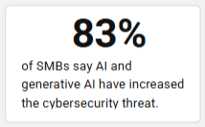
Only 51% of SMBs have implemented any AI security policies at the time of this article, despite the near-universal recognition of the threat it represents. This gap between awareness and action is one of the most significant vulnerabilities in the SMB landscape today.
What This Means for Your Business:
It is becoming harder for employees to recognize threats. AI-powered attacks are more convincing, more personalized, and more frequent, which dramatically increases the risk of human error.
What You Can Do:
- Train employees regularly on evolving phishing and social engineering tactics
- Establish verification protocols for unusual or urgent requests, especially those involving financial transactions or credential access
- Implement email security and endpoint protection tools capable of detecting advanced, AI-assisted threats
The Real Business Impact
Cyber incidents are not IT problems. They are business crises. The downstream effects of a single successful attack can touch every part of your organization and linger long after systems are restored.
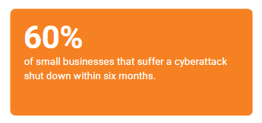
Potential impacts include:
- Operational downtime and lost productivity
- Direct revenue loss during and after the incident
- Damage to customer trust and long-term brand reputation
- Regulatory and compliance exposure
- Recovery costs that often far exceed the initial ransom or incident response fees
For many SMBs, even a short disruption has consequences that extend well beyond the incident itself. The financial math is stark: prevention consistently costs a fraction of recovery.
Why the Smartest SMBs Work with an IT Partner
Cybersecurity has grown more complex than most internal teams can manage alone, not because of a lack of effort, but because the threat landscape now demands round-the-clock monitoring, specialized expertise, and integrated tooling that most businesses simply cannot maintain independently.
"Only 14% of SMBs consider their cybersecurity posture to be highly effective.” -Cybersecurity Magazine; ConnectWise / Vanson Bourne
An experienced IT partner, operating on a unified platform built specifically for this environment, can close that gap. ConnectWise-powered partners, like DP Solutions, bring together the tools, intelligence, and 24/7 coverage that reactive, piecemeal approaches cannot match.
The right IT partner can help you:
- Identify risks and vulnerabilities before attackers do
- Monitor systems continuously, not just during business hours
- Respond to threats faster and earlier in the attack lifecycle
- Build a long-term security strategy aligned to how your business actually operates
In a threat environment defined by speed and trust abuse, reactive security is no longer an option. The question is not whether your business will face a threat; it is whether you will be ready when it arrives.
If you're unsure where your greatest cybersecurity risks exist, now is the time to find out. DP Solutions can help you assess your current security posture, identify potential gaps, and build a practical strategy to strengthen your defenses before an incident occurs.
Contact our team to schedule a cybersecurity assessment and start building a more resilient business.
Comments