
How AI is Impacting Your Business
AI is no longer something businesses are experimenting with on the sidelines. It's already built into the tools your team uses, the applications your vendors provide, and the way customers interact with organizations every day.
For small and mid-sized businesses, that creates both opportunity and responsibility.
Teams are using AI to draft emails, summarize information, automate tasks, improve customer experiences, and make faster decisions. At the same time, cybercriminals are using the same technology to create more convincing phishing attacks, automate fraud, and scale their efforts in ways that weren't possible a few years ago.
The businesses using AI well are not the ones using it the most. They are the ones using it in a way that makes their people more capable, their customers better served, and their decisions better informed.
Whether you have formally adopted AI tools or not, AI is already part of how your business operates. The question is not whether to engage with it. That decision was made for you. The question is whether you have a plan for getting the most out of AI while managing it responsibly.
This is where having the right technology partner can make a difference. DP Solutions helps organizations understand where AI is already at work in their environment, how to use it effectively, and how to manage it responsibly.
AI is Already Working Across Every Part of Your Operation
AI is operating inside and around businesses of every size, in every industry, right now. Here is where it is most likely showing up in yours:
In Your Inbox
Your team can draft faster, respond more professionally, and communicate at a higher level thanks to AI built into the existing tools. That frees your team to put their energy into the conversations that actually need a person. But that same technology is also in the hands of people trying to trick your staff. Phishing emails now read as if they came from a trusted vendor or colleague because they were written by AI to look exactly that way. The opportunity and the risk arrive in the same inbox.
In Your Customer Interactions
AI-powered tools help businesses respond faster and stay available around the clock without the overhead a larger team would require. They're also capable of processing data about your clients and your operations, so knowing what moves through them matters. The speed and availability are real advantages. The key is making sure AI supports the human side of those relationships rather than substituting for it.
In Your Operations
The time your team spends on repetitive work is shrinking. AI is taking on tasks that used to take hours and completing them in a matter of minutes, giving people back time for work that actually requires their attention and judgment. The unfortunate thing is that most of those tools arrived without a review. Someone found something useful, started using it, and moved on. Understanding what is running in your environment and what those tools can access is where responsible AI use begins.
In the Threats Targeting You
Understanding how AI is being used against businesses like yours is an advantage. Awareness is what separates a business that catches a threat early from one that does not. Cybercriminals are using AI the same way everyone else is, to move faster and do more with less effort. Attacks are more targeted, more convincing, and harder to detect than in previous years.
In Your Security Posture
Most businesses did not build their security posture with AI tools in mind. Every AI tool that enters your environment creates a new connection point, and each one deserves a deliberate decision about what it can access and what it does with that information. Businesses that build that habit tend to stay ahead of security risks. The ones that don’t find out the hard way.
In the Decisions Your Team Makes
A two-person team with the right AI tools can now move at a pace that used to require four. That is a genuine shift in what a business can realistically accomplish. The businesses getting the most out of it are the ones where AI handles the groundwork and people own the final call. That is where a smaller team starts to feel like a much larger one.
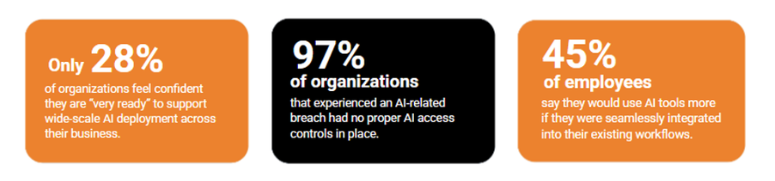
Getting the Most Out of AI Means Knowing the Risks
A business that understands these areas is already ahead of most. Knowing where AI tends to create friction means you can get in front of it rather than clean it up.
Unreviewed Phishing
AI-crafted phishing is harder than ever to spot. Staff who learned to look for typos and odd formatting are now dealing with messages that look and read like the real thing. Regular awareness and updated training make a real difference.
Shadow AI Tools
When employees add AI tools without a review process, the business ends up with applications it did not choose connected to data it may not have intended to share. A simple policy around approved tools easily closes this gap.
Unmonitored Data Flow
AI tools process and sometimes store information. Without visibility into what your tools are doing with your data, compliance and confidentiality gaps can develop quietly and be difficult to untangle later on.
AI Without Oversight
A pricing error can go out to your entire customer list and still look polished and professional. A client message that commits to something it should not have can land before anyone reads it. The issue is not that AI makes mistakes; it’s that it makes them with complete confidence, at whatever scale you happen to be running.
What Smart, Safe AI Use Looks Like for Your Business
The businesses getting the most out of AI share one thing. They kept people at the center of how they use it.
Someone owns it
A clear point of accountability for AI tools and usage policy means decisions get made intentionally. That person does not need to be a technology expert. They just need to be someone who asks the right questions before a new tool goes in.
New tools get reviewed
Before a new AI tool or application goes into the environment, someone checks what it accesses, where the data goes, and whether it aligns with your current security posture. A ten-minute conversation before installation prevents the kind of gaps that take weeks to untangle after.
Your team knows the boundaries
Staff understand which tools are approved for work use and which require review before they are installed. They also know what information is appropriate to share with AI tools and what should remain protected. Clear expectations help employees avoid accidentally entering confidential, client, financial, or proprietary business information into AI platforms
AI outputs get a human check
Anything AI generates that feeds into a real decision gets reviewed before it becomes action. Speed is valuable. Accuracy is more valuable. That final review is what turns AI from a shortcut into a dependable part of how your business operates.
Security coverage includes AI
Your protection is built around how your business actually operates today, including the AI tools in your environment. Coverage that was designed before AI became part of your stack may have gaps you cannot see until something goes wrong.
You have a partner who keeps up
AI moves fast. Having an advisor who stays current on both the opportunity and the risk means you do not have to track it yourself. When something new emerges, you’ll be the first to hear about it.
Get the Most Out of AI Without the Guesswork
Make sure AI is working for your business, not against it. That means making AI an asset rather than a liability. Here is what that looks like in practice:
-
AI Environment Assessment
Identify what AI tools are already in your environment, what they have access to, and where the gaps are. -
Usage Policy Development
Build a practical AI usage policy your team will actually follow, tailored to how your business operates. -
Security Coverage Review
Ensure your security posture reflects the tools your team is actually using, including AI-powered applications. -
Staff Awareness Training
Prepare your team to recognize AI-enhanced phishing attempts and make smart decisions about the tools they use. -
Strategic AI Guidance
As AI evolves, evaluate new tools and opportunities so you can move forward with confidence. -
Ongoing Monitoring and Security Coverage
Maintain continuous visibility into your environment so that when new technologies appear, new threats emerge, or new exposures open up, they’re caught early rather than after something goes sideways.
AI is already in your business. Let’s make sure it’s working for you.
At DP Solutions, we work with businesses that want to use AI confidently, without the risk of getting it wrong. Let us show you what that looks like for your business. Reach out to us today.
Frequently Asked Questions (FAQ)
What are the biggest risks of using AI in business?
Common risks include sharing sensitive information with AI tools, using unapproved applications, receiving inaccurate AI-generated outputs, compliance concerns, and increased exposure to AI-enhanced phishing and fraud attempts.
What is Shadow AI?
Shadow AI refers to employees using AI tools without organizational review, approval, or oversight. This can create security, privacy, compliance, and data governance risks if businesses don't understand what information is being shared with those tools.
Can employees safely use tools like ChatGPT or Microsoft Copilot at work?
Yes, when organizations establish clear guidelines around approved tools, acceptable use, and what data can and cannot be entered into AI platforms. Employees should understand how to use AI responsibly without exposing confidential, client, financial, or proprietary information.
What information should not be entered into AI tools?
Organizations should carefully evaluate whether employees should enter:
- Client or customer information
- Personally identifiable information (PII)
- Financial records
- Protected health information (PHI)
- Intellectual property
- Source code
- Confidential business information
Acceptable use policies should clearly define what information is approved for AI use.
How can AI improve business productivity?
AI can help automate repetitive tasks, summarize content, assist with drafting communications, analyze information, improve customer response times, and support decision-making. When used appropriately, AI allows employees to spend more time on work that benefits from human expertise and judgment.
Does AI replace employees?
AI works best as a tool that enhances employee productivity rather than replaces people. The most successful businesses use AI to handle routine work while keeping humans responsible for oversight, judgment, relationship-building, and decision-making.
Should my business create an AI policy?
Yes. An AI policy establishes clear expectations around approved tools, acceptable use, data protection, security requirements, review processes, and employee responsibilities. It provides a framework for using AI consistently and responsibly across the organization.
Comments